
Orange Juice
Your
quarterly
vitamin.
Written on 04/15/21 9:12 AM

Our own Tyler Bryant chatted this week with Helene Parker on her Programmatic Digest Podcast, about how to partner with programmatic and digital vendors. Tyler is the Digital Media Director here at RPM, and it’s safe to say he is one of the most passionate and intelligent digital strategists around. See for yourself and check out the podcast here or listen on Apple Podcasts.
 With the success in recent years of streaming content providers such as Netflix, Amazon Prime Video, and Hulu, major tech and content players have entered the scene. In late 2019, Disney and Apple launched their own streaming products. NBCUniversal (NBCU)—the parent company of Comcast and the NBC family of networks—is the next conglomerate to unveil a streaming service: Peacock.
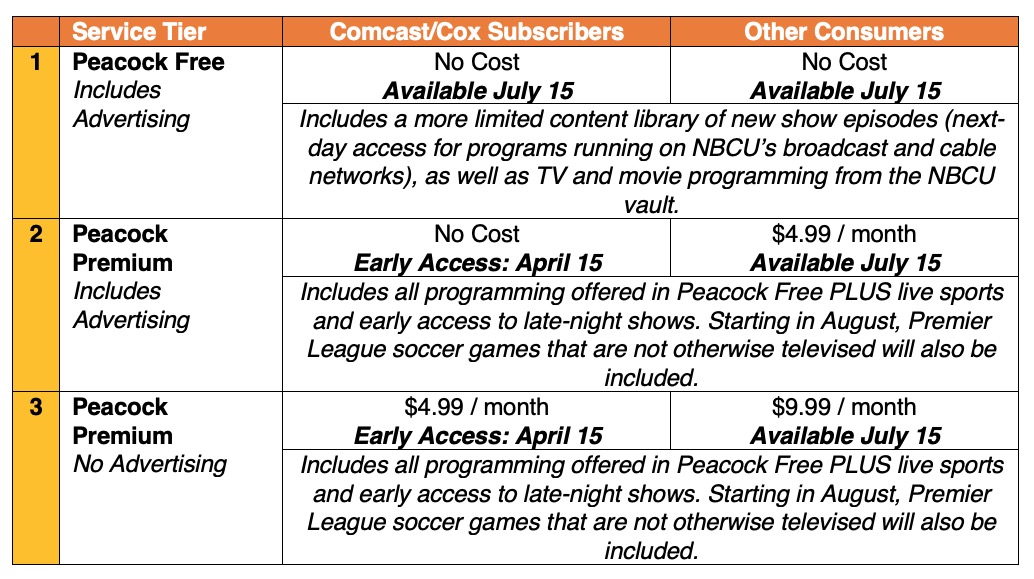
According to The Verge, NBCU will be offering consumers three tiers of service with different offerings and price points depending on whether a consumer is a Comcast / Cox cable customer:
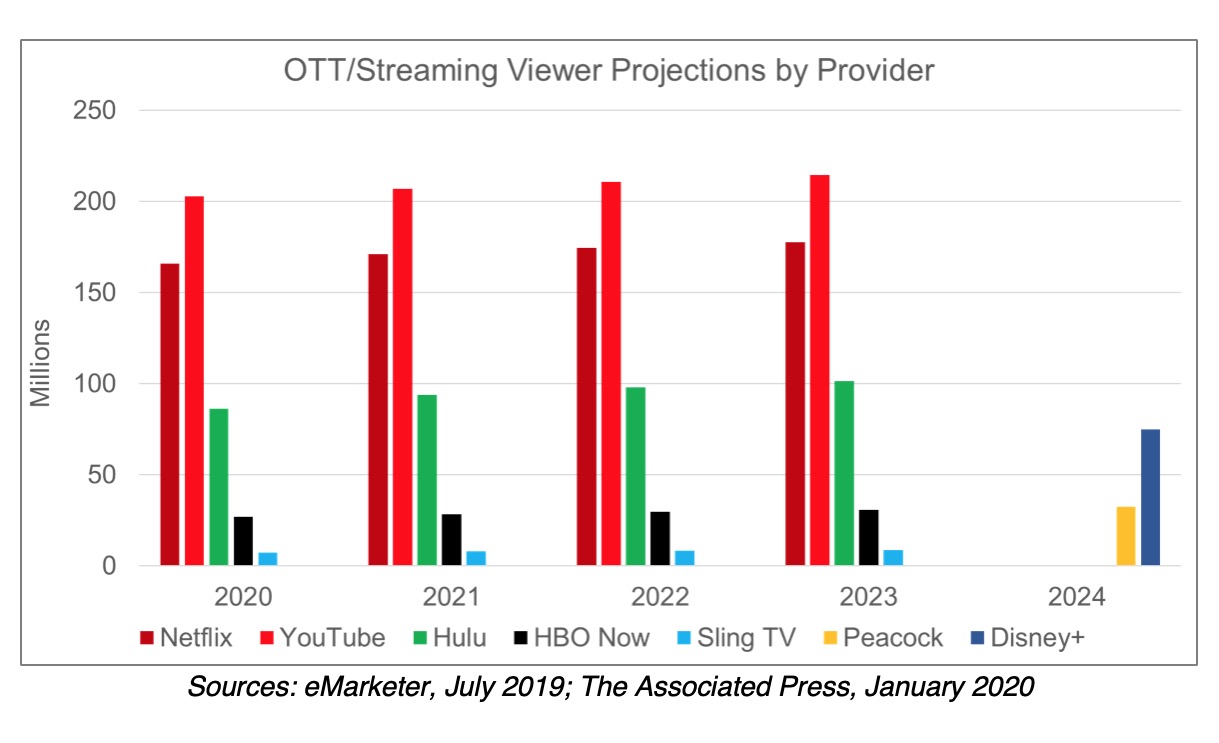
Subscriber Projections. NBCU is taken a conservative approach in estimating, and possibly in growing, its subscriber counts. As shared with the Associated Press, NBCU is projecting 30 to 35 million Peacock accounts by 2024. The chart below shows how Peacock would stack up if it meets projections. (Please note that 2024 data for Netflix, YouTube TV, Hulu, HBO NOW, and Sling TV are not available. Viewer projections for Peacock and Disney+ prior to 2024 are not readily available at this time.)
Peacock for Advertisers. The ad-supported tiers will have fewer and/or shorter commercial pods, totaling less than five minutes per hour. This is far less than commercial-to-programming ratio on linear TV (11 minutes on average and 17-18 minutes for NBCU networks, specifically) or on Hulu (9 minutes). Having fewer commercials will be beneficial to both viewers and brands thanks to the reduced advertising clutter. NBCU will also carefully plan the ad load so that viewers will not see the same ad more than once in a 30-minute block; frequency capping issues have historically plagued ad-supported streaming services, on demand, and other digital video players when not well managed.
From CNBC reporting, here are the planned ad types on Peacock:
| Pause ads | which would take over the whole screen of your device when a viewer pauses a show with messaging around “taking a break” |
|---|---|
| Binge ads | will trigger when a consumer watches three episodes of a show, and a sponsor will bring a fourth episode ad-free |
| Shoppable TV | ads let viewers buy products that are related to the shows they’re watching. |
| Prime Pods | are single, 60-second ad spots |
| Engagement ads | will attempt to get consumers to interact with advertisements using trivia questions or product galleries |
| Trending ads | will show advertisements that are based on certain topics |
| Solo ads | will limit advertising to a single ad within an episode of a show |
| Curator ads | will curate collections of NBCUniversal titles based on moods, genres, events or other themes, with the opportunity for brands to sponsor those collections |
| Explore ads | will show a collection of content related to what a viewer was watching while they’re paused, offering an option for a viewer to get a discount sent to their phone if they’re interested in the product being shown. |
Peacock already has national advertisers (Target, State Farm Insurance, Unilever) on board for a co-promotional push to generate interest and sign-ups.
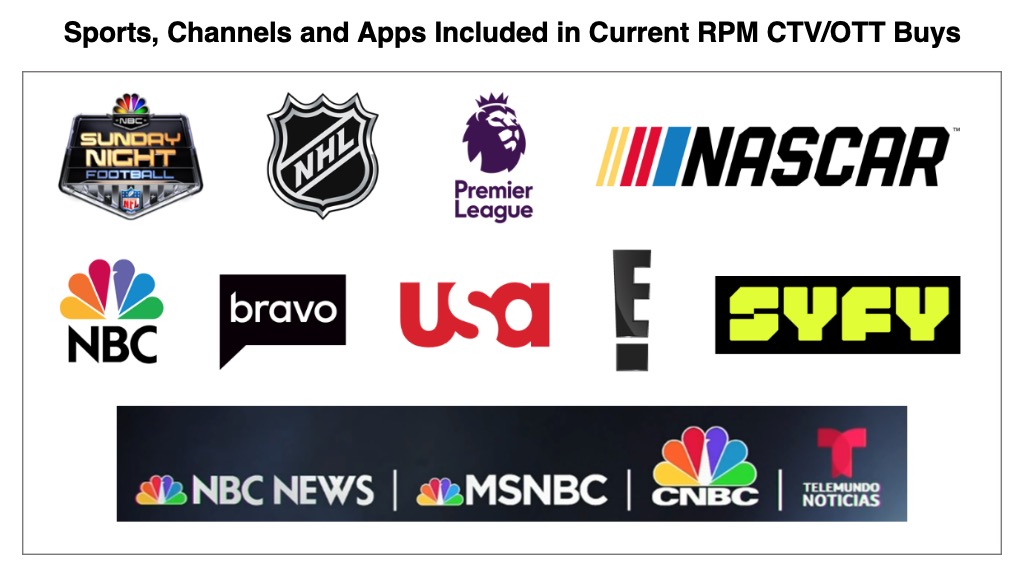
No clear word as of yet if ad buys will be possible at the local level and/or through programmatic buying. RPM will keep our regional and local clients apprised of any developments. RPM currently includes NBCU networks and apps in its CTV/OTT buys for clients. This includes the following live sports and the following channels and apps.
- Sources:
- thetimestribune.com/cnhi_network/nbc-hopes-free-makes-peacock-stand-out-in-streaming-era/article_3519109c-3d45-11ea-bf5b-77b2fa9bbb40.html
- theverge.com/2020/1/16/21068607/nbc-peacock-streaming-service-price-launch-date-ads-universal-comcast-office-harry-potter
- cnbc.com/2020/01/16/nbcus-peacock-will-have-no-more-than-five-minutes-of-ads-per-hour.html
- adexchanger.com/platforms/peacock-unveils-ad-platform-with-performance-style-ads/
- deadline.com/2020/01/nbcuniversal-expects-2-5b-in-peacock-revenue-break-even-by-2024-1202833243/
 Have you ever struggled with figuring out how to expand your advertising reach to people, but you’re unsure of what interests/behaviors to target? Instead of trying to decide if adding a particular TV show to the targeting list will help, try the Interest Expansion tool to take advantage of the Facebook algorithm.
Detailed targeting allows advertisers to choose interests or behaviors on top of demographic targeting. For instance, detailed targeting for dog food would likely be something like:
Men and Women
Ages 21 – 60
Living in the United States
Interested in dogs, dog food, or dog toys
With Interest Expansion, however, you can allow the Facebook algorithm to reach more people than just those specified in your detailed targeting.
If Interest Expansion is enabled, a portion of the budget will be tested to find additional people who may get more and/or cheaper results. Budget will be shifted to the audience that is getting more results at a lower cost. So in our above example, interest expansion would find people who might not fall under the interests you specified, but are likely interested in what you have to offer. It allows advertisers to expand their reach to find more potential customers.
The downside? Facebook doesn’t tell you what interests are being tested or produce results. It’s unclear whether that feature will ever become available.
To enable interest expansion, go to your ad set → Audiences → Detailed Targeting. In that section, check the box labeled “Expand detailed targeting criteria when it may increase conversion at a lower cost per conversion.”

 In an effort to be more transparent, Facebook has released a feature called Off-Facebook Activity. This allows users to see a summary of the apps and websites activity that Facebook collects and clear this information from their account. People can also choose to have this data disconnected from their account in the future. The removed data cannot be used for targeting moving forward.
Facebook receives this activity through businesses and organizations sharing it when they use Facebook business tools like the Facebook Pixel, the Facebook SDK and Facebook Login. It uses this information to:
● Show you more relevant ads.
● Suggest groups, events, or Marketplace items you might be interested in.
● Help you discover new businesses and brands.
● Help businesses and organizations understand how their website, app, or ads are performing and whether they’re reaching the right people.
● Identify suspicious activity to help keep Facebook safe.
What does this mean for advertisers? Potentially less people to target. If you’re a casino and you want to reach those who have expressed interest in casinos, then Off-Facebook Activity would allow people to clear those interests from their account and you would miss the chance to connect with those people.
It’s hard to say whether or not users will take full advantage of this new feature. They need to be concerned about their data, know how to enable it, and most importantly they need to opt out rather than opt in, which likely means more people will continue without using Off-Facebook Activity.
Facebook began rollout of the feature in the United States on October 1, and since then isn’t reporting any negative feedback. Here at RPM, we also haven’t seen any performance decline, but will continue to closely monitor in the coming months.
Facebook is playing the long game by giving users more control and information about how advertisers use Facebook’s tools. By educating about marketing practices, Facebook believes it can gain more trust among its users to keep them engaged on the platform (and providing data).

