
Orange Juice
Your
quarterly
vitamin.
Written on 11/8/17 9:11 PM
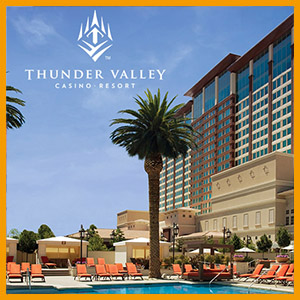 When our Client-Partner, Thunder Valley Casino Resort, made an adjustment to their customer relationship marketing program, specifically the redemption policies for its buffet, it had a negative impact on covers in the restaurant for 2017. In response, RPM was charged with developing a marketing program to drive business back to the buffet. The result was a TV spot within the “Live Out Loud” campaign that positioned the restaurant as a fantasy dining experience, a feast for the senses at each and every station in the buffet. The campaign launched in mid-September and by the end of the first month, revenue had increased significantly over the same period a year earlier. On YouTube, “Chef Spectacular” has already exceeded 35k views. On track to outpace revenue projections for the year, the increased buffet traffic adds incremental revenue to Thunder Valley’s casino floor. As we like to say, game on!
 Analytics is embedded in everything today’s marketers do. This not only requires a cultural shift that impacts how marketing teams work together as much as it impacts what they do. An analytical marketing approach requires that teams act differently, as much as it demands that they think differently based upon what data is telling them.
In this Harvard Business Review article, Adele Sweetwood, the Senior Vice President of Global Marketing and Shared Services at SAS, looks at three approaches to build an analytical culture. The idea of a “common analytical culture” helps organizations develop the ability to make adjustments on the fly, creating the opportunity to implement real-time changes and empowering the marketing [are we missing a word here? Team? Group?] to respond more quickly. She looks at three ways that teams in an analytical culture must think differently.
- Use data to change the status quo – Teams need to think differently about marketing because the availability of new data and metrics allow them to be more effective and enable them to identify new approaches
- Use stories to convey data insights – Teams can ask what-if questions to uncover other stories it can begin to tell, enabling teams to shift from being reactive to proactive, creating a culture focused on the future, rather than having one weighed down by the past.
- Use different metrics – In the past, metrics provided something to react to, but today reacting to metrics isn’t enough. Customers now have greater expectations about what they expect us to know as marketers and how we interact with them.
Learn more about how an analytics mindset changes marketing culture, read the full article here.
There has been a lot of talk about “cleaning up” the digital media supply chain, but what does this mean? And how can clients ensure transparency when it comes to digital media investments?
 Mark Pritchard, Chief Brand Officer for P&G, spoke at the Interactive Advertising Bureau’s Annual Leadership Meeting in Hollywood, Florida, on January 29th and announced, “The days of giving digital a pass are over, it’s time to grow up. It’s time for action.” His words were a reaction to the confusing and often non-transparent digital ecosystem that surrounds the industry. He stressed that P&G does “not want to waste time and money on a crappy media supply chain.” He encouraged others in the industry to follow his lead. P&G is expecting that all of their media vendors and partners adhere to the accredited Media Rating Council (MRC) guidelines for viewability, fraud protection, verification, and transparency.
It appears that Mark’s words are sinking in, because recently Facebook has agreed to an audit of the information it sends marketers, hoping to increase trust and transparency. While there have always been complaints about the lack of transparency and consistency in social reporting, P&G has companies scrambling to give them what they want, which will benefit all of us in the long run. While other platforms like Twitter have yet to follow suit, Facebook’s move shows that social platforms need to continue listening in order to boost their credibility—especially as companies continue to see the importance of data.
Last year, RPM announced “Project Clean Ads”, where viewability and fraud protection are automatically engrained into the digital planning and buying process. All digital display ads through our vendor-partners must adhere to the MRC standards of:
- Display: 50% of ad pixels must be viewable on desktop/PC for 1 continuous second
- Video: 50% of ad pixels must be viewable on desktop/PC for 2 continuous seconds
- All ads must be Fraud Free
We are encouraged by Facebook’s new approach to accepting third-party verification and hope that other social media and digital ad tech providers will do the same. We all benefit by supporting and holding our partners accountable for what we purchase, because at the end of the day we all want what’s best for our client-partners—high quality inventory that provides value and delivers on our goals.
Credits and Sources:
http://adage.com/article/media/p-g-s-pritchard-calls-digital-grow-up-new-rules/307742/
http://measurementnow.net/what-is-3ms/#.WKtrWfkrI2w
Skill-Based Slots Make Their Debut
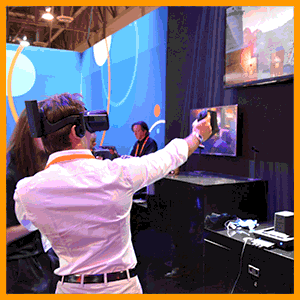
There is a truism in the casino world: Slots are the kings of cash.
At RPM, we learned that on our first day in the casino business over 15 years ago, and it still holds true today. Slots are where the money flows. They are fast-paced and high volume. They come with a relatively small footprint compared their table game cousins, and they never ever take lunch breaks, vacations, or call in sick.
But there is a subtle shift in how the goose is laying its golden egg, and casinos and slot manufacturers are taking note. No longer are slots paying out purely by randomness. Skill-based slots are here.
Just as the name suggests, there is an element of skill involved in a game like “Danger Arena,” the first of its kind in the U.S. that pits the player against robots, and the more robots you kill, the higher the payout. Danger Arena debuted in the fall and so far is available only in Atlantic City. But it, and more like it, are coming soon to Nevada, and other markets are sure to follow.
The ultimate goal of these skill-based games: attract a younger audience to gaming machines.
Traditionally, slot players have skewed older, and in the past several years, younger players have looked elsewhere for entertainment. When they visit casinos, a good chunk of their time – and money – is spent in clubs, by the pool, at shows, or in shops.
So the big question facing casinos is how to get Millennials off the dance floor and onto the slot floor. The answer is a blend of Xbox and jackpots.
If the younger crowd viewed traditional slots with an apathetic eye, the new skill-based games are hoping to turn heads, millions of them. One survey identified a mix of 23 million Millennials, Gen Xers, and Baby Boomers who play video games at home and also visit casinos. 1
But if you consider yourself a video gaming guru ready to make a fortune at the new wave of slots, not so fast. Like always, the house will keep its edge and there are many random variables that will determine your potential payout.
Think of these skill-based games kind of like blackjack. You could be the sharpest player at the table, but if all you’re getting dealt are 14s and 15s, your blackjack acumen can only do so much. Danger Arena, for instance, has more than 10,000 “maps” so that each game is different. Sometimes it’s easier, and sometimes you’ll feel like you got dealt a 15 against the dealer’s face card.
New York-based GameCo and Gamblit Gaming out of California are two of the leading manufacturers of skill-based games. GameCo developed Danger Arena and the recently introduced “Pharaoh’s Secret Temple,” another Atlantic City exclusive. Other games on the horizon include titles based off popular movies like “Terminator 2,” “Mission: Impossible,” and “Ferris Bueller’s Day Off,” as well as a basketball-themed game called “Nothin’ But Net.”
Still in their infancy, skill-based games could be in most U.S. gambling markets by the end of this year. 2
What does all this mean for marketers? Well, eventually the question we will ask audiences will evolve from “Do you feel lucky?” to “Do you have mad skills?”
1 – “A Hands-On Look at Skill-Based Casino Games”
2 – “GameCo Debuts “Pharaoh’s Secret Temple in Atlantic City”


Hollywood Casino Jamul-San Diego is the newest entrant into a crowded gaming market, with three established competitors all within a short driving distance of the new property. As a later entrant into the market, Hollywood must compete with entrenched properties with prevailing local market awareness, brand affinity and a strong database.
RPM was challenged to begin building brand awareness prior to the opening, and to drive interest by getting the word out that the property would be premiering soon.
Using the Hollywood Casino brand as the foundation, RPM’s strategy was to embrace the San Diego culture and position Hollywood Casino as San Diego’s casino. This included the development of a fully integrated campaign that used San Diego’s cultural touchpoints as our guide posts, creating a framework for all messaging and creative. We wanted to weave Hollywood Casino into the local community fabric and reach San Diegans in their everyday lives to forge a direct connection with them.
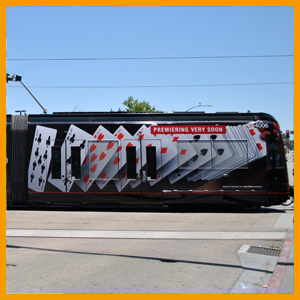
To bring the strategy to life RPM used a multi-channel approach and developed tactics with the San Diego experience in mind, including visuals of the San Diego skyline, highlighting proximity positioning (Closest Casino to San Diego), leveraging locally based F&B outlets, and building media partnerships with key stations and vehicles such as commuter buses and trolleys.
The “Premiering Soon” campaign launched in June 2016 and created pre-opening buzz that garnered the attention and awareness Hollywood was after – and set up the new property for success in a highly competitive market. Measures for success included pre-launch advertising awareness and online engagement.
Results:
- In a short time-frame, campaign generated significant brand awareness in a locally competitive market place
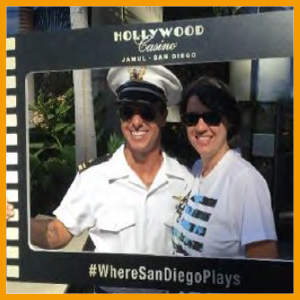
- Impressions generated with street team engagement and celebrity impersonators present to take photos during two local festivals, led to thousands of social media engagements
- Facebook Page Likes spiked in correlation to paid advertising campaign
- CTR higher than the company benchmark for Facebook Page Like Ads
- Cost Per Page Like much lower than benchmark with weekly creative and targeting optimizations that serve the most relevant ad to the most engaged user
 Whether it’s on a mobile device, the web, or a gaming floor, customers are leaving footprints of behavior. The era of “Big data,” driven by improvements in computing power and innovations in data analysis, enables gaming brands to access enormous caches of customer data and leverage that data to stimulate customers to make decisions. From targeting offers to customizing advertising creative, big data is changing how brands interact with consumers. What are companies learning, and how are they using the data they collect?
In a panel with Google Head of Insights & Analytics and the President and CEO of IRI, Chicago Booth marketing professor Sanjog Misra looks at how big data is changing marketing. Watch the video here:
 The fourth quarter brings with it the greatest number of holidays, and that has marketers looking for even more ways to increase engagement (and hopefully revenue as well).
Consumers often complain that the barrage of holiday campaigns begin earlier and earlier each year, so why do marketers keep moving up the calendar? Because it works. According to the National Retail Federation, 20% of consumers have already started shopping for the holidays in September, with almost half starting by Halloween. Not all shoppers are bothered by the blinking holiday trees well in advance of the big day, with only one-third of consumers claiming that early holiday launches drive them crazy.
But when it comes to email campaigns, are all holidays created equal? And does marketing early and often turn consumers off, or get results? Although holiday promotions can drive sales, starting email promotions earlier doesn’t necessarily mean better results. In fact, for some holidays, the earlier promotions are sent, the weaker they perform.
When developing holiday email campaigns, keep in mind: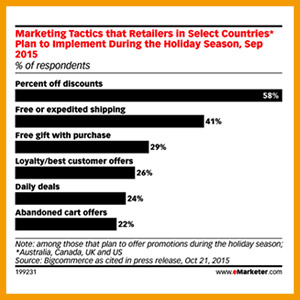
- Thanksgiving and Black Friday benefit from later email deployment
- In 2014, Thanksgiving and Black Friday-themed emails sent far in advance of the holidays experienced open rates that were 14.6% and 10% lower compared to base communications
- Cyber Monday open rates are higher for emails sent the weekend before, rather than the day of (which elicit open rates comparable with base communications)
- Christmas-themed emails experience higher open rates throughout December, although open rates tend to be higher in the first half of the month and just prior to the holiday
Consumers are planning to increase their online holiday shopping in 2015, with 35% of those anticipating making more than half of all purchases on-line. Discounts, special promotions and retargeting will play an important role in helping marketers engage consumers, and the smart use of email can make a big difference.
I Harvard Business Review, September 2014
II Yesmail, Engagement and Deliverability for Holiday-themed Email, 2015
III CivicScience, October 2015
Today Thunder Valley Casino and Resort, located just 30 miles east of Sacramento, CA, is a full-fledged AAA Four Diamond resort destination lauded for its accommodations, entertainment and large selection of slots and table games. In addition to offering over 250,000 square feet of gaming space, the resort is home to a luxury 300-room hotel, world class spa, 14 restaurants and bars and three award-winning entertainment venues – including a 5,000 seat Outdoor Amphitheater.
The United Auburn Indian Community-owned casino resort has evolved and grown since its opening in 2003. When RPM was selected as its agency partner in 2013, the property was facing increased competition with the opening of a new casino resort in the Northern CA gaming market.
With RPM on board, the team had set goals to protect Thunder Valley’s market share, which included repositioning the property, revising the media mix to reach its target audience, and breathing new life into the Thunder Rewards loyalty program with new creative and branding. The results of those efforts are paying dividends, with the casino resort thriving even in the face of new competition:
Market leader
Double digit growth for new loyalty card sign-ups
Expanded audience growth, including millennials, which is outpacing all other generational segments
Increase in non-gaming transactions, including significant gains in retail outlets
Development of sub-brand-within-a-brand campaigns (The Poker Room at Thunder Valley, High Steaks Steakhouse, the only AAA Four Diamond steakhouse in the area, Illusions, the area’s only ultra-lounge
As Thunder Valley sought to once again up its game, the resort casino’s website was a prime opportunity to connect with its audience, drive loyalty, and spur growth for its diverse offerings. Once again, Thunder Valley looked to RPM.
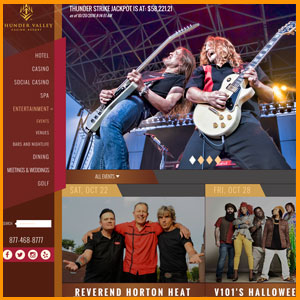
The engagement started by understanding and analyzing Thunder Valley’s audience and how they would engage with the site and ensuring a user-centered design that would minimize steps to complete transactions, such as hotel bookings and ticket purchases. Ease of use was paramount and the RPM team set about determining sequences of interaction and ways to streamline and simplify the user experience, such as the ability to discover key promotions, events and experiences.
With an objective to digitally recreate Thunder Valley’s brand experience, the website redesign utilizes all the striking elements and luxurious touches that perfectly illustrate what it means to “Live Out Loud.” Stronger calls to action and visual cues direct users deeper into site, and responsive design ensures a consistent, easy experience regardless of device. The site architecture and links make pages easy to find and navigate, while search engine optimization (SEO) ensures that search engines can crawl the site more easily and find pages, which improves organic rankings.
“The new website has exceeded our expectations,” says Kathy Hickman, Vice President of Marketing. “In the next two to four years the Northern CA gaming market will become even more competitive and Thunder Valley will have a lot at stake. RPM has played, and will continue to play, a critical role in developing Thunder Valley’s plans to ensure our leadership position.”
We can probably assume you know what Pokemon Go is by now. With over 25 million people walking around the country with their heads buried in their phones, yelling “woo!” every time they catch a mythical creature… there’s a pretty good chance you’ve been witness to the phenomenon. There will be roughly twice the number of Pokemon Go players today than people on Facebook. To say that the augmented reality-based game is a spectacular success is putting it mildly.
Really, it’s a screaming 200-decibel wake-up call for marketers and brand managers everywhere.

Think about it. We’re talking about a brand that’s over 20 years old. In their day, the original Pokemon cartoons spawned a rabid following of little kids who collected playing cards and Picachu dolls. It limped along on tv and in video game form for years and years.
Suddenly, someone has the brilliant idea to bring a decades-old cartoon franchise together with an existing location-based mobile game called Ingress (a sort of capture the flag for the digital world) and bam! We’re talking millions and millions of users around the world all interacting and participating in a brand that until recently existed mostly for young children and nerdy millennials.
Within days, this bit of digital genius has not only breathed new life into the brand, it’s creating an entirely new Pokemon universe that continues to move and grow as we speak. For anyone who doubts the tremendous power of the digital-social medium, imagine what 25 million new customers every day could do for your bottom line.
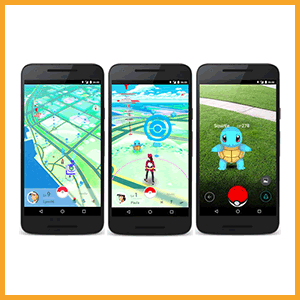
And all of it for the price of producing a moderately expensive 30-second tv commercial. For those marketers who are paying attention, Pokemon Go has offered some valuable lessons:
Branding is more important than ever. The platform that Pokemon Go is built on has been around for quite some time. The mobile game Ingress received scant attention when it was unveiled. Only after the Pokemon brand was added did it become a successful formula. Millions of people continue to connect with the game because it’s a story they know and are eager to re-experience. Even in the digital realm, cool games can only get you so far – an authentic brand story is still the heart and soul of any successful effort.
You don’t need a huge ad campaign. Pokemon Go didn’t use a single television ad to promote its introduction. The overnight success was built on the strength of its concept. The simple fun and nostalgia players experienced turned into millions of tweets and posts and endless word-of-mouth on social media. The simple fact is, you don’t need gobs of money to be an effective marketer. There are endless ways to connect with your customers nowadays.
Literally any brand can reinvent itself. Over the years Pokemon has constantly reimagined itself – from cartoons to toys to card games and video games. But connecting with the mobile platform finally gave fans an opportunity to live the Pokemon experience like never before. They could actually participate in the story of the brand.
The most obvious lesson of course, is that if you’re not already dedicating serious time and resources to the digital-social world, you’re very late to the party and it’s time to jump in head first. This new marketing universe offers unparalleled opportunity for igniting a groundswell of interest and excitement in your brand.
So start the conversation. Begin exploring your brand story. 25 million new customers are waiting.
Life is a bit more bubbly at RPM these days as we’ve been thrilled to work with Riondo Prosecco, an Italian sparkling wine from Terlato Wines.

If you’ve checked out cocktails recipes on Pinterest or Instagram these days, you’ll know that prosecco is this summer’s “it” drink. From sparkling cocktails to summer popsicle treats, everyone is talking about prosecco! But even though it’s becoming the trendy everyday choice, not many brands are making a splash—that’s where we came in.
With prosecco becoming a more attractive option across the market, it was important to distinguish Riondo from its competition from the very start. Its authentic Italian roots and refreshing frizzante style made for a natural brand positioning – Riondo Prosecco is Italian for “summer.” We’re talking about the laid-back European summertime style of alfresco dining, flower-lined terraces and everyday celebrations.
Based on the nature of prosecco’s social popularity, our team was excited to focus on digital and social media for the official launch of the Riondo Prosecco brand. While our internal team is running community management and creating unique posts for Facebook and Instagram pages, we’re also teaming with a variety of popular blogger and social influencer networks to build the brand’s online presence. Bloggers immediately fell in love with the brand and created inventive summer cocktail recipes and party ideas with Riondo. Original content and the individual flair of each blogger’s social presence made this an ideal fit for the brand and the perfect way to introduce Riondo Prosecco to a growing following.
This is just the beginning of a fantastic partnership with Riondo Prosecco and it’s been amazing to see the brand begin its takeoff into social media prominence.
Want to learn more, or discuss how we can help your brand? Contact Jennifer Wiza at jwiza@rpmadv.com.